


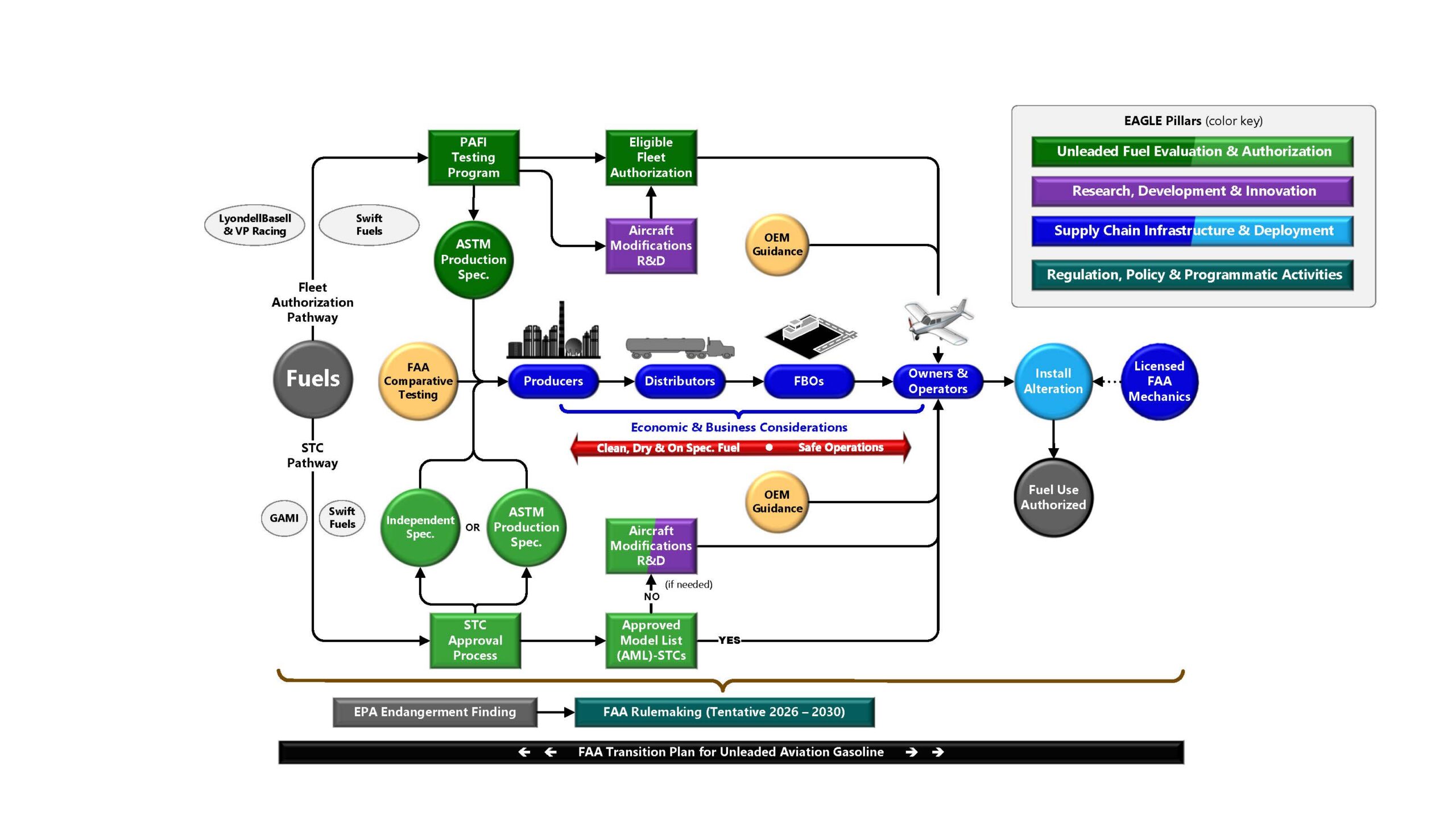
FAA’s Transition Plan for Unleaded Aviation Gasoline gives aircraft owners, pilots, and industry stakeholders a roadmap for the general aviation industry’s shift to unleaded fuel. While a significant milestone, the plan represents a dynamic framework that FAA will further refine as testing, fuel distribution, and market data mature throughout Phases 1 and 2 of the transition.
For aircraft owners, the primary focus remains clear: ensuring replacement fuels operate without adversely impacting the safe and efficient operation of the existing general aviation fleet.
Current Status of Unleaded Fuel Candidates
-
G100UL: GAMI’s G100UL has broad Supplemental Type Certificate (STC) approval for engines and airplanes (rotorcraft in process).
-
100R: Swift Fuels’ 100R is approved for approximately 1,200 piston engines and 1,600 airframes via STC. Additionally, Swift Fuels has rejoined FAA’s Piston Aviation Fuels Initiative (PAFI) and continues work toward wider fleet authorization.
-
UL100: VP Racing Aviation and LyondellBasell’s UL100 is in FAA’s PAFI testing program, with initial portions of the fleet authorization targeted for 2027.
As unleaded avgas options continue to become available at airports, owners and pilots are encouraged to diligently verify the approval status of each fuel for their specific aircraft and engine configuration. This includes completing any required placarding or documentation and following applicable installation, operating, and maintenance instructions to support the safe use of unleaded fuel in their aircraft.
Comparative Testing and Comingling Concerns
In addition to the PAFI testing of UL100 and 100R, FAA is conducting comparative testing of all three candidate fuels against 100LL, evaluating detonation performance, materials compatibility, toxicology, fuel composition, engine durability, and the effects of mixing the fuels with each other.
While each unleaded fuel can safely mix with 100LL in aircraft tanks, testing is still underway to determine if the unleaded fuels can mix with each other, and, if not, explore appropriate safety mitigations. Complete understanding of fuel mixability will be essential for pilots navigating airports with potentially different fuel offerings, as well as for fixed-base operators (FBOs) managing storage, labelling, dispensing, and misfueling precautions.
Scaling Production and Infrastructure
Achieving full fleet transition relies on aligning production, supply chains, airport infrastructure, pricing, and market demand. The transition presents an industry catch-22: fuel distributors may hesitate to initiate a transition to another fuel until most aircraft are authorized to use that fuel, while refiners require steady customer demand before expanding production. Meeting the fleet’s projected annual demand of 180 million gallons will require deliberate coordination across refiners, distributors, FBOs, and other industry stakeholders.
Supporting 100LL Availability During Transition
To maintain fleet safety and operational continuity, airports must continue to offer 100LL throughout the transition process per FAA Grant Assurance 40. Transition timelines will adjust as production, distribution, and fleet readiness reach necessary levels, with tailored considerations for remote regions like Alaska. The sole supplier of TEL has committed to working with EAGLE in support of the transition toward unleaded avgas.
Moving Forward Together
Aircraft owners and operators should treat FAA’s plan as a roadmap for an orderly transition—not as an instruction to change fuels tomorrow. Pilots and operators are encouraged to review authorizations that cover their aircraft and engines, interact with fuel developers, and learn more about how they can support the transition to unleaded fuels at flyEAGLE.org. Pilots and operators who have already chosen an unleaded fuel are further encouraged to help shape a data-driven transition by sharing their operational insights. Under FAA SAIB 2025-04, pilots, mechanics, and fixed-base operators are encouraged to submit real-world performance feedback, ranging from routine, problem-free flights to service difficulties, directly to the FAA at OperationalSafety@faa.gov.
Airports, FBOs, distributors, and stakeholders are also encouraged to collaborate with EAGLE to find the most efficient means possible to facilitate the industry’s transition to an unleaded fuel.
A successful transition to an unleaded future depends on an orderly process grounded in safety, sound data, aircraft compatibility, fuel availability, and practical operations. FAA’s plan provides a framework for this work, giving the aviation community a shared roadmap to guide the fleet forward thoughtfully.
Stay Informed & Engaged
Access official updates, check aircraft approval statuses, and download transition resources at flyEAGLE.org.
Eliminate Aviation Gasoline Lead Emissions (EAGLE) is a comprehensive government-industry initiative consisting of the aviation and petroleum industries and U.S. government stakeholders, and a wide range of other constituents and interested parties, all working toward the transition to lead-free aviation fuels for piston-engine aircraft by the end of 2030 without compromising the safety or economic health of the general aviation industry. To learn more, visit: https://flyEAGLE.org.
